Fritz Pfeffer joins the Secret Annex
Diary of Anne FrankFritz Pfeffer joins the Secret Annex in November 1942, becoming its eighth resident as reports of escalating persecution lead the people in hiding and their helpers to decide that sheltering one more person is worth the added strain. His arrival is both a practical expansion of the household and a revealing episode in the Annex’s system of concealment: he is led through the ordinary office below, past a concealed entrance, and into a hidden family whose existence he had not known.
Why the Annex takes in another person
By November 1942, the residents had considered that there might be enough space and food for one more person, but feared imposing an additional burden on Mr. Kugler and Mr. Kleiman. As reports of what was being done to Jews worsened, Otto Frank raised the idea with them; both agreed that taking in an eighth person was an excellent plan. The decision weighs a limited household’s capacity against the danger facing those left without refuge. The helpers’ assessment, as Anne records it, is that the danger is already present whether there are seven residents or eight.
The choice falls on Pfeffer, a dentist known to the family through a superficial acquaintance and also known to Miep. Anne describes him as quiet and refined, qualities that make him seem likely to fit into the extended household. Otto rejects the van Daan relatives before the group settles on him. The decision is thus not simply a question of finding a vacant bed: they seek someone who can be incorporated into a family-like arrangement maintained under concealment.
A carefully arranged arrival
The plan is enabled by the office building that already shelters the residents. The Frank family had originally agreed to go into hiding on July 16, but Margot’s call-up notice advanced their departure by ten days. Their refuge is in Otto’s office building, where only a small number of employees know that the family is there. The contrast between the building’s public business and its concealed upper-floor household shapes Pfeffer’s entry as much as it shapes the family’s original escape.
Miep arranges for Pfeffer to meet a man at a particular place in front of the post office at eleven in the morning. Johannes Kleiman meets him, tells him that the man he had expected cannot come, and asks him to visit the office; Kleiman returns by streetcar while Pfeffer follows on foot. At the office, Miep asks him to remove his coat so that his yellow star will not be visible, then keeps him in a private office while the cleaning woman is still present. When she can safely move him, she takes him upstairs, opens the bookcase, and passes through the hidden entrance as Pfeffer watches in amazement.
The ordinary route into the hiding place depends on a division of knowledge. The office workers who are helping the family know about the residents, while the warehouse staff and two assistants have not been told. The building’s lower floor is a working warehouse, with rooms including a stockroom and a milling room where spices are ground. This makes the move through the office a calculated passage through a functioning workplace, not an open arrival at a known refuge.
Recognition, surprise, and welcome
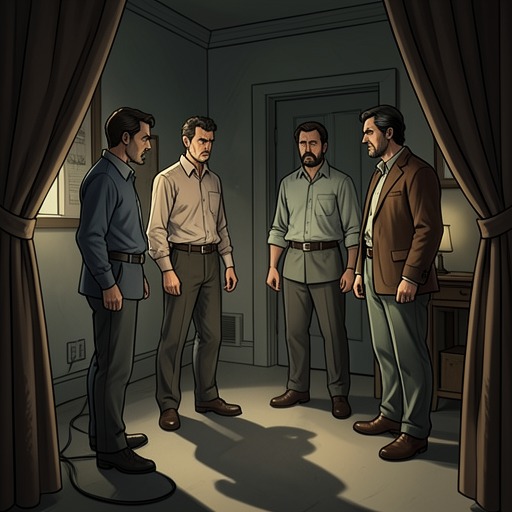
While Miep is bringing him through the building, the seven residents wait around the dining table with coffee and cognac. She first leads Pfeffer into the Frank family’s room. He recognizes the furniture but does not realize that the family is concealed directly above him. Only after Miep explains does she bring him upstairs. He is so startled that he nearly faints; seated among the people he thought were elsewhere, he stares in silence, struggling to understand how they came to be there.
His surprise exposes the success of the false story the family had spread. The residents explain that they had deliberately circulated a rumor involving an officer and a car to mislead the Germans and anyone else who might look for them. Pfeffer had believed that their escape to Belgium was genuine and that the expected officer and vehicle were part of that plan. The encounter turns the ruse from an abstract security measure into a specific revelation: the family’s apparent absence was staged, and their real refuge has been hidden in the office building all along.
After the explanation, Pfeffer looks around the Annex, and the group shares lunch. He naps, joins them for tea, puts away the few belongings Miep had managed to bring in advance, and begins to feel more at home. The movement from astonishment to meals and settling in marks the immediate practical outcome of his admission: the newcomers’ arrival becomes part of the household’s daily routine.
Life under shared rules and renewed danger
Pfeffer’s admission requires the residents to adjust their arrangements. The plan had assigned him a place in Anne’s room, while Margot would use a folding bed; after he arrived, Margot instead slept in her parents’ bedroom. The change shows how adding a resident redistributed privacy and sleeping space throughout an already constrained household. To welcome him, the residents also give him a typewritten set of rules and regulations, presenting their life together through an ironic notice for accommodation available “all year round” in quiet surroundings in the heart of Amsterdam, free of charge and on a low-fat diet. Its mock hospitality recasts the necessities of hiding as the language of a lodging establishment.
The danger that makes this household possible also makes it precarious. During a later break-in, Peter discovers that both the warehouse door and street door are open. The residents follow standing safety instructions: they do not wash or run water, remain quiet, dress by eight, and do not use the bathroom. The thieves take cashboxes, blank checkbooks, and the household’s coupons for 330 pounds of sugar. This episode shows the material stakes of concealment: a breach in the building threatens both the residents’ safety and the fragile supplies on which they depend.
After a later security scare, precautions tighten further. Fritz Pfeffer is assigned to do his work in the bathroom, Peter patrols the house from eight-thirty to nine-thirty, and the residents can no longer flush the toilet after nine-thirty at night. A night watchman is hired, and a carpenter from the underground is expected to build a barricade from white Frankfurt bedsteads. The details make clear that the Annex is not a settled refuge but a space continually reorganized around the risk of discovery. Pfeffer’s arrival begins as an effort to bring someone else to safety; it takes place within a household whose safety remains conditional, dependent on rules, vigilance, and help from beyond its hidden rooms.
Significance of the episode
The episode connects large-scale persecution to minute decisions about rooms, routes, furniture, and timing. Anti-Jewish restrictions had already limited where Jews could travel and shop and what public activities they could undertake; the prospect of worsening danger now draws the Annex residents and helpers into a further act of sheltering. In this account, the office building’s working spaces and concealed entrance are not background alone: they are the means by which the group can extend protection while keeping its existence secret.
The diary also preserves the layered work behind the episode. Anne first wrote for herself, then began a second, edited version after hearing a call for eyewitness accounts of occupation; she selected, revised, and supplemented material while continuing the original diary. Otto Frank later drew from both versions to produce a shorter published text, omitting some passages for length, contemporary publishing conventions, and consideration for the dead. After questions about authenticity prompted an investigation, the manuscripts were published in a critical edition; the Anne Frank-Fonds later commissioned Mirjam Pressler to prepare an expanded edition with about 30 percent more material. Pfeffer’s entrance is therefore presented not only as a household event, but as part of a record whose successive versions shaped what readers could learn about life in hiding.